The blue diamond standard, what the auction records tell collectors
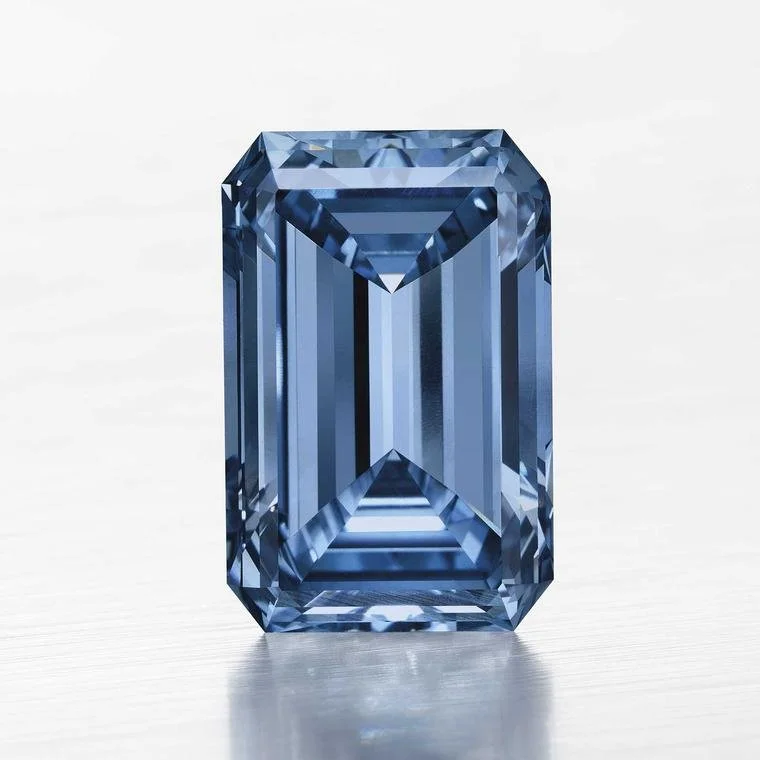
In May 2016, a 25-minute bidding war between two anonymous buyers ended with a single stone selling for $57.54 million at Christie's Geneva. The Oppenheimer Blue (14.62 carats, Fancy Vivid Blue, VVS1) became the most expensive blue diamond ever sold at auction. It exceeded its pre-sale estimate by more than $12 million.
Six years later, in April 2022, an eight-minute bidding war between four buyers at Sotheby's Hong Kong produced $57.47 million for the De Beers Blue (15.10 carats, Fancy Vivid Blue, Internally Flawless), the largest Fancy Vivid Blue diamond ever offered at auction. The two results sit within $70,000 of each other. The market had not softened between 2016 and 2022. It had deepened.
These results did not surprise anyone in the trade. They confirmed what the blue diamond market has been signaling for a decade: at the highest tier of the category, demand is structural, supply is geological, and the auction results are not outliers. They are the market telling you something.
Blue diamonds have appreciated 242 percent since 2005 according to the Fancy Color Research Foundation. Pink diamonds have outperformed that figure. But blue diamonds occupy a different position in a collector's thinking, one that is less about momentum and more about permanence. The stones are rarer. The science behind them is more specific. And the institutional recognition, from Sotheby's, Christie's, and every major private collection, is absolute.
What makes a diamond blue
Every colored diamond gets its color from an element or structural anomaly that interrupted the pure carbon lattice during formation. In yellow diamonds, that element is nitrogen. In blue diamonds, it is boron.
Boron is one of the rarest trace elements found in natural diamonds. Its presence during formation deep in the earth's mantle, under conditions of extreme pressure, is a geological accident of the highest order. The result is a Type IIb diamond: a stone that not only absorbs light in the red and yellow spectrum to produce blue, but can actually conduct electricity. No other gemstone does this. It is a physical property unique to boron-bearing diamonds that distinguishes them at a scientific level from every other stone in the colored diamond category.
The intensity of the color depends on the concentration of boron and the specific conditions under which the crystal grew. At the highest concentration, the result is Fancy Vivid Blue, the designation that defines every stone in this piece.
The Cullinan mine: the only address that matters
The De Beers Blue was found in South Africa's Cullinan Mine, the same source that produced the Cullinan Diamond in 1905. At 3,106 carats, it was the largest gem-quality rough diamond ever found, and the two largest stones in the British Crown Jewels were cut from it.
Cullinan is the dominant source of significant blue diamonds globally. It does not produce them consistently. Blue diamond discoveries of any size are still sporadic and always an astonishing occurrence. When a significant blue rough emerges from Cullinan, it is an event. The stone is tracked, the cut is deliberated over for months, and the result is offered either privately or through the world's leading auction houses.
Only a few mines globally produce natural blue diamonds: South Africa, India, and occasionally Australia. Cullinan produces the stones that define the category. That geological concentration is not a commercial arrangement. It is a fact of the earth's formation, and it is permanent.
The records, and what they tell collectors
Four results define the blue diamond category at collector level. Every serious buyer should know them precisely.
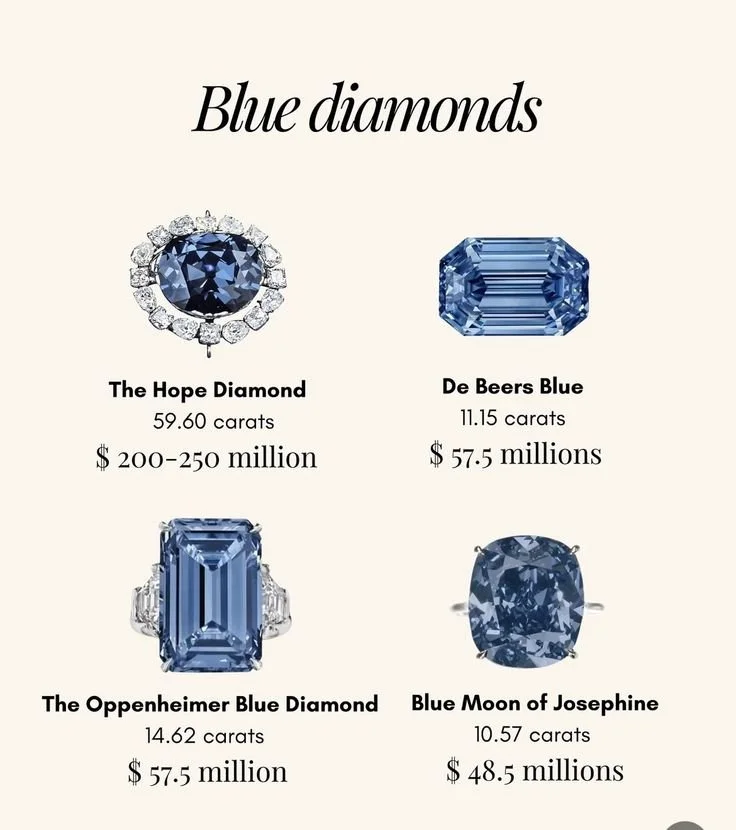
The Oppenheimer Blue (14.62 carats, Fancy Vivid Blue, VVS1) sold for $57.54 million at Christie's Geneva, May 2016. It holds the overall auction record for any blue diamond. It was named after Sir Philip Oppenheimer, late chairman of the De Beers Diamond Syndicate, who had given the stone to his wife. The bidding lasted over 25 minutes. The stone sold to an anonymous telephone bidder.
The De Beers Blue (15.10 carats, Fancy Vivid Blue, Internally Flawless) sold for $57.47 million at Sotheby's Hong Kong, April 2022. It is the largest Fancy Vivid Blue diamond ever offered at auction, and the most significant blue diamond result in Sotheby's history. It was discovered at the Cullinan Mine in 2021. An eight-minute bidding war between four buyers took the price more than $9 million above its pre-sale estimate.
The Blue Moon of Josephine (12.03 carats, Fancy Vivid Blue, Internally Flawless) sold for $48.5 million at Sotheby's Geneva, November 2015. It holds the per-carat record for any blue diamond at auction at $4.02 million per carat, and was the first diamond or gemstone ever to surpass $4 million per carat. It was purchased by Hong Kong billionaire Joseph Lau for his seven-year-old daughter, after whom it was named.
The Bleu Royal (17.61 carats, Fancy Vivid Blue, Internally Flawless) sold for $43.8 million at Christie's Geneva, November 2023. It is the largest internally flawless Fancy Vivid Blue ever to appear at auction. It sat in a private collection for 40 years before its auction debut, and became the most expensive jewelry lot sold by any auction house worldwide in 2023.
Every one of these stones carries a Fancy Vivid Blue grade. Not Fancy Intense. Not Fancy. Vivid. That designation is not a preference. It is the entire investment thesis.
Fancy Vivid Blue: the only grade that compounds
The GIA intensity scale for blue diamonds runs from Faint through to Fancy Vivid and Fancy Dark. The gap between Fancy Intense Blue and Fancy Vivid Blue in price per carat is not incremental. It is categorical.
A Fancy Vivid Blue diamond at significant carat weight trades at multiples of what a Fancy Intense Blue of equivalent size achieves. The reason is simple: Fancy Vivid Blue at any size is among the rarest designations GIA assigns. Combined with the geological specificity of Type IIb formation and the near-exclusive dominance of the Cullinan mine as the primary source, the supply constraint is not a market condition. It is a physical reality.
The certificate for a blue diamond at collector level must confirm three things without ambiguity: Fancy Vivid Blue intensity grade, Natural color origin confirmed by GIA, and Type IIb classification. Without all three, you are in a different category entirely, and the market prices that difference with precision.
What this means at the point of acquisition
Blue diamonds at investment grade are not found at retail. They move through private networks, appear at the world's leading auction houses, and are sourced through direct relationships with the trade. The stones that define the category (the Oppenheimer Blue, the De Beers Blue, the Blue Moon of Josephine) were each in private hands before they were ever photographed for a catalog.
The collector who understands the category before a stone is presented makes a fundamentally different acquisition than the one who encounters the stone first and the knowledge second. Origin confirmed. Grade confirmed. GIA certification without qualification. Those are the conditions under which a blue diamond becomes a compounding asset rather than a significant purchase.
The Cullinan mine will continue to produce blue diamonds sporadically. Each significant rough that emerges will attract the same institutional attention, the same bidding competition, and the same results that have defined the category for the past decade. The supply equation does not change. The demand equation only strengthens.
That is the blue diamond argument. It does not require embellishment.
Private inquiries regarding fancy color diamond acquisition are handled personally by Claudia. Contact via WhatsApp or the SLIMMS website.
Further reading: Sotheby's, The Six Most Expensive Blue Diamonds: sothebys.com/en/articles/discover-the-6-most-expensive-blue-diamonds