The yellow diamond hierarchy
From Fancy Light to Fancy Vivid, and why the distance between them is measured in tens of thousands of dollars per carat.

The grading indication on a GIA certificate separates an $8,000 stone from an $80,000 one. That word is "Vivid."
Yellow diamonds are the most accessible entry point into the fancy color category. They are more available than blue. They are more available than pink. They are significantly more affordable at equivalent size. For a collector building a position in natural fancy color diamonds, that accessibility is often where the conversation begins.
But yellow is also the category where the widest gap in the market exists between stones that hold value and stones that do not. That gap is not about size. It is not about cut. It is determined almost entirely by one line on the GIA certificate: the intensity grade.
Understanding that grade and what separates each level from the one above it. The difference between acquiring something that compounds and acquiring something that simply looks impressive in the light.
What nitrogen does and why it matters
A yellow diamond gets its color from nitrogen atoms embedded in its crystal structure during formation. Nitrogen absorbs light in the blue end of the spectrum and reflects it back as yellow. The more nitrogen present, and the more evenly distributed within the crystal lattice, the more saturated the color.
This is not a treatment. It is not an enhancement. It is a geological accident that took billions of years to produce and cannot be replicated in a laboratory with the same economic result. Nitrogen is common roughly 98% of natural diamonds contain it. The formation conditions required to concentrate it at the level that produces a Fancy Vivid Yellow are not.
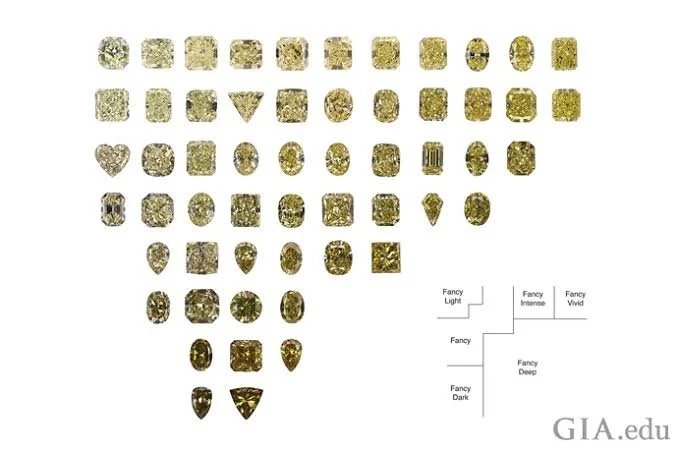
The intensity scale and where the value lives
GIA grades yellow diamonds on a nine-point intensity scale: Faint, Very Light, Light, Fancy Light, Fancy, Fancy Intense, Fancy Vivid, Fancy Deep, Fancy Dark.
Each step represents a measurable increase in color saturation. Each step also represents a significant change in price per carat.
Fancy Vivid Yellow is the designation that changes the conversation entirely. Fancy Vivid Yellow diamonds command premium prices of $8,000 to $16,000 per carat, a multiple of what Fancy or Fancy Intense stones achieve at equivalent size and quality. The color must be pure, saturated yellow with no modifying tones that dilute it. No greenish. No brownish. The saturation must read at the highest register on the GIA scale.
The Graff Vivid Yellow, 100.09 carats, cushion-modified brilliant sold for $16.8 million at Sotheby's Geneva in 2014. It stands among the few yellow diamonds exceeding 100 carats ever recorded, and its significance is underscored by its inclusion in Ian Balfour's Famous Diamonds, a definitive reference published in 2008. In December 2023, Sotheby's sold an exceptional unmounted 133.03-carat Fancy Vivid Yellow diamond for $5.5 million — the largest Fancy Vivid Yellow diamond to ever sell at auction at that time.
There is a gap. The gap between Fancy Intense Yellow and Fancy Vivid Yellow is not a stylistic preference. It is a valuation category.
What the FCRF data actually shows
The Fancy Color Research Foundation publishes a quarterly index tracking wholesale prices across yellow, pink, and blue fancy color diamonds. It is the most credible benchmark the category has.
The honest picture on yellows requires nuance. Since beginning its data collection in 2005, the FCRF has documented an overall increase of 205% across all Fancy Color Diamonds. Yellow diamonds have risen by 49.3% over that period. That is real, long-term appreciation — but it trails the pink and blue categories significantly, and the recent data reflects softness in the broader yellow segment.
The Q1 2026 FCRF release shows yellows unchanged for the quarter, down 1.2% on a trailing twelve-month basis. The category has been under modest pressure. But the detail within the data is where the investment thesis lives.
Fancy Vivid Yellow diamonds, all sizes, reversed a 2.2% decline in Q4 2024 to flat performance in Q1 2025, signaling growing support and a slowdown in selling pressure for this vivid sub-category. The softness is concentrated in Fancy and Fancy Intense grades. At the Vivid level, the floor is establishing.
This is the distinction a serious buyer needs to understand. The FCRF index tracks the yellow category as a whole. Within that category, intensity grade determines which stones are softening and which are holding. Fancy Vivid Yellow is not the same acquisition as Fancy Intense Yellow. They are different assets.
The certification standard
GIA is the laboratory for natural diamonds. There is no equivalent discussion here, unlike colored stones, where the Swiss laboratories hold a different standard, GIA is the definitive authority for diamond grading globally.
The certificate must state Fancy Vivid Yellow clearly. The color origin must be listed as Natural, meaning the color formed in the earth, not through irradiation or high-pressure high-temperature treatment, both of which can alter a diamond's color artificially. Treated fancy color diamonds carry a significant discount and do not hold value equivalently. The certificate makes the distinction explicit.
For a yellow diamond at collector level: GIA certified, Natural color origin confirmed, Fancy Vivid intensity grade, eye-clean clarity, well-proportioned cut. Those five criteria define the acquisition. Everything outside them is a compromise that compounds over time.
Where yellow sits in a colored diamond portfolio
Pink and blue diamonds have outperformed yellow significantly over the twenty-year FCRF data set. Pink diamonds have appreciated roughly 391% since 2005, and blue diamonds roughly 242% over the same period. Yellow at 49.3% over the same period is a different proposition.
That gap reflects supply dynamics. Yellow diamonds are produced in higher volumes than pink or blue. More supply means more liquidity, lower premiums, and more modest appreciation curves. The collector's case for Fancy Vivid Yellow is not the same as the case for Argyle pink or Cullinan blue. It is a more accessible entry into the fancy color category — with a longer holding horizon and a very specific grade requirement to make the investment case.
What yellow offers that no other color can: visibility. A fine Fancy Vivid Yellow in a significant size is immediately, unmistakably extraordinary. It does not require explanation. It announces itself. For a collector who wants both the financial case and the wearability, at an entry point below pink and blue, Fancy Vivid Yellow, correctly graded, correctly certified, is the acquisition.
One final point on natural versus treated
Laboratory-grown yellow diamonds and color-treated natural yellows are widely available and visually indistinguishable from natural Fancy Vivid Yellows without specialized equipment. GIA's certificate is the only document that confirms natural color origin definitively. Without it, the acquisition has no investment basis. With it, you hold something the earth took billions of years to produce and will not produce again in any volume that changes the supply equation.
That is the standard. It has not changed and will not.
Private inquiries regarding fancy color diamond acquisition are handled personally by Claudia. Contact via WhatsApp or the SLIMMS website.